Ocean intelligence: Unlocking a sustainable path for the ocean economy
For decades, the maritime industry has operated in the dark. Despite covering 70% of our planet, the vast majority of the seabed remains a "data desert." Traditionally, mapping the ocean floor required massive, diesel-burning survey vessels and months of manual data processing — a logistical bottleneck that has held back offshore energy development, subsea infrastructure, and ocean-dependent industries for decades.
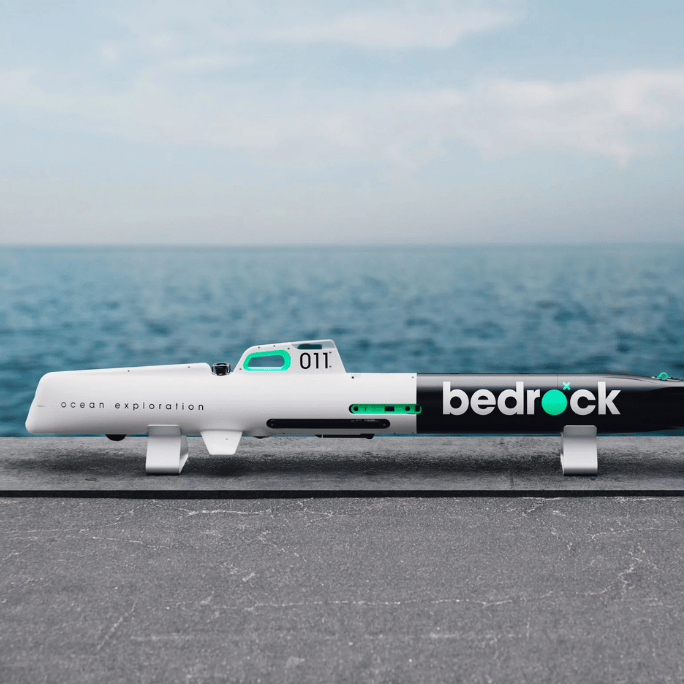
Bedrock Ocean Exploration is the intelligence infrastructure for the ocean economy, and its modular platform powers maritime operations with comprehensive ocean intelligence at unprecedented speed.
.png)
Vertically integrated modular architecture
Bedrock’s breakthrough is not just a vehicle; it owns the full stack, encompassing physical ocean acquisition, swappable sensors, the intelligence pipeline, and the customer delivery interfaces.
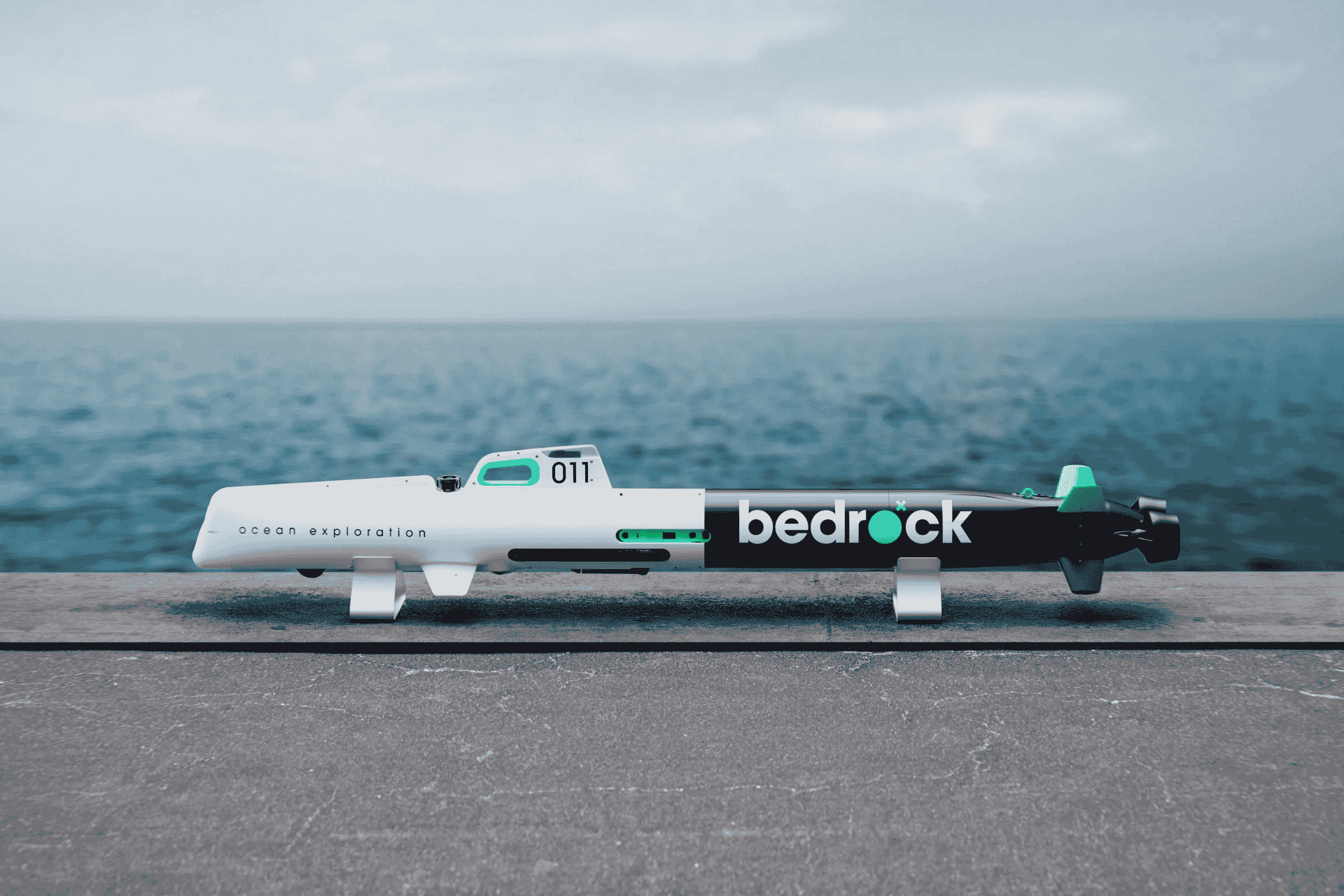
- Expeditionary, Low-Logistics Operations: Bedrock’s custom-designed Autonomous Underwater Vehicle (AUV) is 100% electric and "vessel-agnostic." It can be launched from any locally available boat — a fishing vessel, a tugboat—turning a standard ship into an intelligence acquisition node. This eliminates the need to mobilize massive, carbon-intensive offshore survey vessels from distant ports.
- Insights Inside the Decision Window: Most underwater drones log raw sensor readings to a hard drive. Bedrock’s AUVs process data while still submerged. This "edge computing" allows the system to perform quality control (QA/QC) in near real-time, delivering insights to stakeholders without waiting days for the vehicle to be recovered and the data to be manually "cleaned".
- End-to-End Automation: Bedrock’s automation extends to launch and recovery, fleet management, and insight delivery, shifting the unit economics from single-platform operations to a resilient fleet model.
Bedrock operates across the most challenging environments in the ocean and keeps people onshore, operating a mission from a desk and delivering geophysical data to customers through its Mosaic™ Platform.
.png)
Proving the efficiency gains
The transition from "innovation" to "industry standard" requires rigorous validation. As of early 2026, several early-stage projects have confirmed that Bedrock’s decentralized approach is outperforming traditional methods in three key areas:
- UK Hydrographic Office Technology Demonstration: Bedrock successfully completed a paid technology demonstration with the UK Hydrographic Office (UKHO), validating its intelligence pipeline in a live operational environment. Paired-AUV survey operations were conducted at sea, with Bedrock’s onboard processing delivering intelligence from seabed to cloud within the mission cycle. The program included collaborative co-processing sessions with UKHO, evaluation of Bedrock’s automated target recognition capabilities against government workflow requirements, and development of change-detection solutions for integration into UKHO route survey databases, confirming Bedrock’s full intelligence stack as fit for some of the most demanding hydrographic standards in the world.
- IHO Special Order Certification: Bedrock’s intelligence has been independently verified to meet IHO Special Order standards, the precision floor required to operate in serious commercial environments — including harbor navigation and subsea cable routing. Reaching this standard with an AUV, without the conventional acoustic positioning architecture the industry long considered non-negotiable, was widely viewed as impractical. Bedrock proved otherwise, clearing the bar that critical infrastructure demands.
- Site Characterization Timelines: In offshore energy pilots, Bedrock’s rapid-mobilization design allowed developers to access insight within days of a weather window opening, rather than waiting weeks for a specialized ship. This has successfully compressed the "site characterization" phase of development—one of the most common delays in offshore energy projects.
Verified impact: Accelerating the green transition
Bedrock’s impact is measured by its ability to de-risk and accelerate offshore energy projects while protecting the environment in which it operates.
- 90% Carbon Reduction: By replacing a traditional 60-meter diesel survey ship with a small, electric AUV launched from a local vessel, Bedrock reduces the carbon footprint of a seabed survey by up to 90%.
- Supporting "SDG 14": By providing affordable, repeatable mapping, Bedrock helps achieve UN Sustainable Development Goal 14 (Life Below Water). Better maps mean better protection for sensitive marine habitats that are often accidentally damaged during industrial construction due to poor or outdated data.
.png)
Strategic backing for global scale
In October 2023, Bedrock secured $25.5 million in Series A funding, led by Northzone and Primary Venture Partners. That capital has fueled a 2026 expansion, scaling the fleet and the team to meet surging demand from the North Sea Summit commitments to accelerate offshore wind and hydrogen networks.
Into 2026, Bedrock has moved from concept to a validated intelligence platform. The seabed is no longer a gap in the picture. It is a continuously updated, queryable intelligence layer — already powering infrastructure decisions, accelerating offshore energy development,and compounding with every mission deployed.