Carbon Ridge and the bridge to net-zero shipping
Global shipping is the backbone of the world economy, transporting nearly 90% of the world’s goods. But this critical industry also carries a significant environmental footprint, accounting for nearly 3% of global CO2 emissions — a share expected to rise as other sectors decarbonize faster.
While the industry is exploring future fuels such as hydrogen and ammonia, these solutions are still years away from large-scale commercial readiness and infrastructure development. At the same time, most vessels operating today are built to last 20 to 25 years. Carbon Ridge is helping to bridge the gap to a net-zero future by enabling meaningful emissions reductions from today's fleet, capturing CO2 directly from a vessel’s exhaust before it ever reaches the atmosphere.
Modular carbon capture for a moving world
Carbon Ridge is taking a new approach to carbon capture, an Onboard Carbon Capture & Storage (OCCS) solution purpose-built for the space-constrained, high vibration, and high-movement environment of an active deep-sea vessel, rather than adapting traditional land-based systems for maritime use.
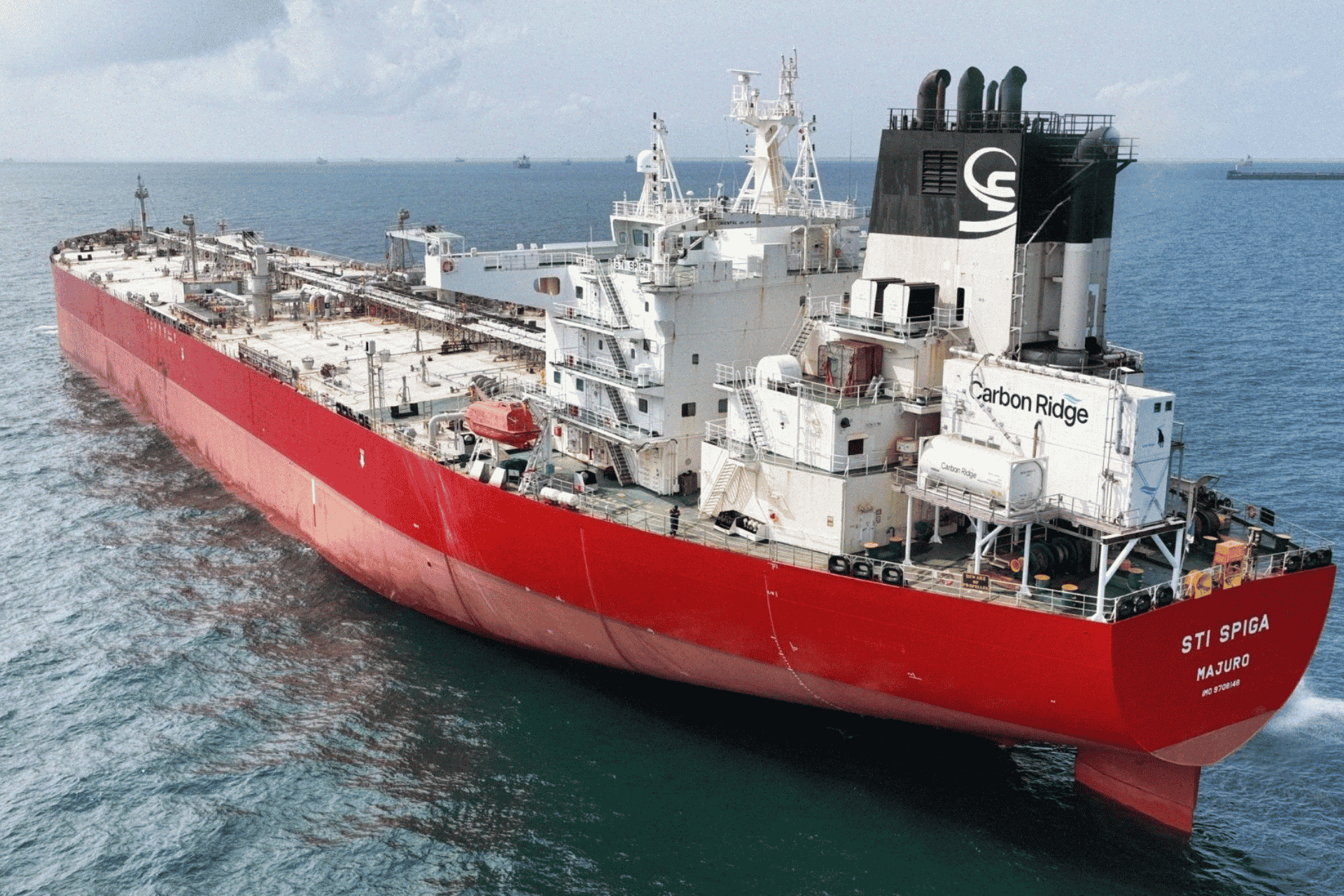
At the core of the technology is Carbon Ridge’s OCCS module, built as modularized units that can be deployed and configured for specific vessel types with minimal structural modifications required. As exhaust gas is routed into the module, a proprietary solvent-based process captures not only CO2, but also harmful NOx and SOx (nitrogen and sulfur oxides). The treated exhaust is then returned to the funnel, while the CO2-rich solvent is processed to separate and liquefy the carbon for storage.
Because onboard space and weight are critical considerations for shipowners, Carbon Ridge developed proprietary high-intensity contactors that allow their system to be 75% smaller than conventional carbon capture columns used on land. This compact footprint is a game-changer, allowing shipowners to install the technology without sacrificing significant cargo capacity or requiring massive structural retrofits that would keep a ship in dry-dock for months.
Flexibility for shipowners is built into the system’s core design. Whether a ship is burning traditional heavy fuel oil, LNG, or emerging biofuels, the modular OCCS can be tuned to capture the emissions regardless of the chemistry of the fuel source. This "fuel-agnostic" approach de-risks the investment for shipowners who are unsure which alternative fuel will eventually dominate the market.
.png)
Early validation: Proving capture at sea
The transition from lab to sea requires rigorous proof of durability. As of early 2026, Carbon Ridge has achieved critical technical milestones through its collaboration with industrial leaders.
Working with Scorpio Tankers, Carbon Ridge validated the system's performance on a commercially-operating LR2. The pilot proved that their OCCS system could maintain stable capture rates despite the constant "pitch and roll" of the ocean, which often disrupts traditional liquid-chemical capture processes.
The system delivered over 99% removal of CO₂, NOx, and SOx emissions, proving that meaningful decarbonization at sea is no longer a future ambition but a present-day reality.
.png)
This milestone marks a pivotal moment for Carbon Ridge as the company transitions from technology validation to commercial scale-up, and it signals a broader shift for the maritime industry: shipowners now have a viable path to meet tightening global climate regulations without waiting decades for alternative fuels to become available at scale.
Carbon Ridge’s impact is measured not just by what is captured on the ship, but by the integration of the entire CO2 value chain. Capturing carbon onboard a vessel is only half the equation — without a clear destination for that CO2, shipowners are left with a stranded solution. Carbon Ridge has built an integrated value chain that connects onboard capture to offloading infrastructure, transport logistics, and permanent storage or utilization, ensuring that every ton of CO2 removed at sea has a verified pathway to long-term sequestration or commercial utilization.
As regulators, charterers, and owners increasingly require verifiable emissions reductions across the full value chain, a piecemeal approach won’t be sufficient – and the companies that can deliver capture, transport, and storage as a single seamless service will define the next era of shipping.